What Happens When Multiple People Share Fault?
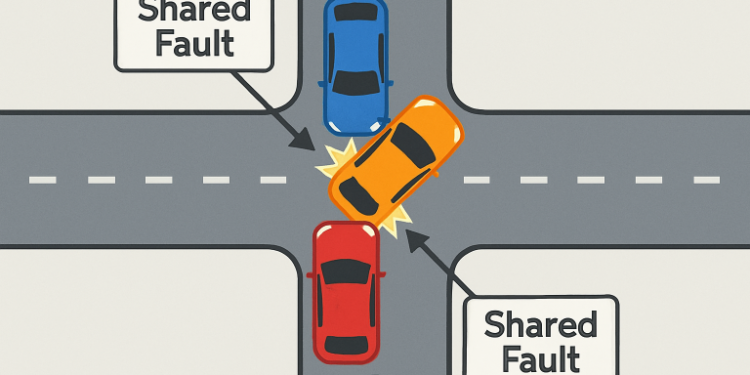
Table of Contents
In many accidents, more than one person or party’s actions contribute to the outcome. When multiple people share fault for an accident, identifying who is responsible and to what extent can become complicated. For anyone involved, learning how shared fault affects compensation and legal outcomes is essential, and sometimes, professional guidance can make a substantial difference. If you need more information about legal support in such scenarios, consider exploring your options for legal help for negligence claims.
Shared fault, also called joint liability or comparative fault, means the blame is distributed based on each party’s contribution to the accident. This can include drivers in car collisions, property owners and visitors in slip-and-fall incidents, or multiple businesses in a commercial mishap. Understanding the principles behind fault allocation ensures your rights are protected, whether you are seeking compensation or defending against a claim.
When several individuals are deemed partially responsible, insurance companies and courts must use specific legal guidelines to determine how damages should be apportioned. This process can directly impact not only compensation but also insurance rates, legal fees, and your long-term record.
Moreover, if you find yourself in a complex liability situation, it is helpful to consult reputable resources, such as FindLaw’s guide to contributory and comparative negligence, for a deeper understanding.
The rules for distributing blame in shared fault cases vary by jurisdiction, but most states follow one of two central legal doctrines: comparative negligence and contributory negligence.
The rules for distributing blame in shared fault cases vary by jurisdiction, but most states follow one of two central legal doctrines: comparative negligence and contributory negligence.
Comparative Negligence
Under comparative negligence, courts or insurers assign a percentage of fault to each party involved. For example, if Driver A in an accident is found to be 70 percent at fault and Driver B is 30 percent at fault, each party’s compensation is reduced by their respective percentage of responsibility. This approach allows claimants to recover losses, even if they share some blame for the accident. Many states use “modified comparative negligence,” which usually bars recovery if a party’s share of fault exceeds 50 percent.
Contributory Negligence
Some states still follow contributory negligence rules, a much stricter system. Here, if any party is found at all responsible for the accident, even as little as one percent, they are completely barred from recovering any damages. This system places a premium on caution and strict adherence to the law, but it can result in harsh outcomes for those injured who bear only a minimal share of the fault.
For a comprehensive state-by-state breakdown of negligence doctrines, you can reference resources provided by major legal publications, such as AllLaw’s overview of comparative and contributory negligence laws.
Determining Fault in Multi-Party Accidents
Establishing fault among multiple parties requires collecting detailed evidence and conducting a thorough analysis. Key components include:
- Police Reports: Officers provide vital records of the accident, noting violations and offering an initial assessment of what happened.
- Witness Statements: Accounts from bystanders or other drivers can clarify timelines, behaviors, and contributing actions.
- Evidence Analysis: Investigators review vehicle damage, road debris, skid marks, and surveillance footage to reconstruct the incident and pinpoint each person’s contribution.
All of this information is crucial in determining each party’s proportionate share of fault and, ultimately, any damages that may be owed or received.
Impact on Insurance Claims
Shared fault impacts how insurance companies process and resolve claims. If a party is found partially responsible, their own insurer may pay for part of the damages, and the policyholder’s premiums might increase as a result. Further, settlements are often adjusted according to the amount of blame assigned:
- Premium Adjustments: Even for a minor accident, having partial fault can result in higher premiums for several years.
- Claim Settlements: An insurance payout will be reduced by the claimant’s share of fault. For instance, someone carrying 20% fault in a $10,000 claim would receive only $8,000, with $2,000 deducted for their share of responsibility.
Real-Life Example: Multi-Car Intersection Accident
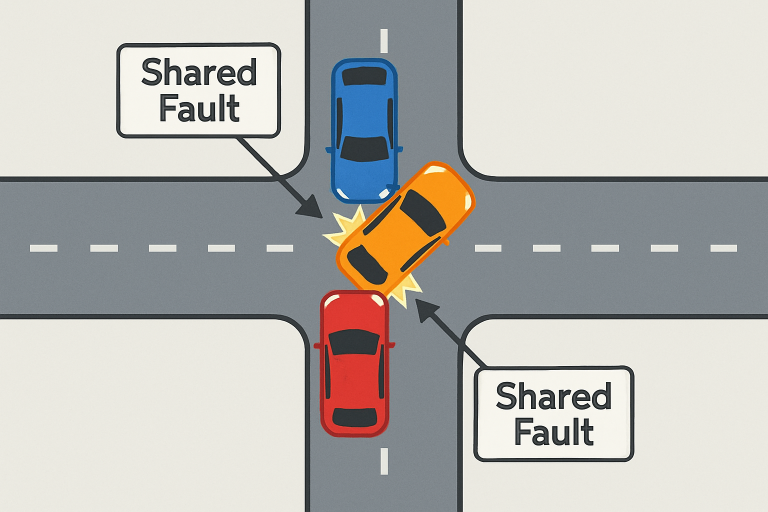
Take, for example, a situation where multiple cars are involved in a crash at an intersection. Driver A runs a red light and strikes Driver B, who happens to be speeding. In an attempt to avoid the collision, Driver C swerves and unintentionally hits a pedestrian. In this scenario:
- Driver A could be held mainly at fault due to failing to observe the traffic signal.
- Driver B may share blame because speeding reduced their time to react and prevent the crash.
- Driver C’s responsibility would be evaluated to see if they took reasonable care while trying to avoid the incident.
This example shows the importance of meticulous investigation and the often-complicated nature of multi-party accidents, where responsibility is not always clear-cut.
If you find yourself in an accident where multiple parties may share fault, here are the steps you should follow:
- Ensure Safety: Before anything else, check for injuries and, if possible, move to a safer location to prevent further harm.
- Contact Authorities: Report the accident to law enforcement. An official record will be vital in determining fault.
- Document the Scene: Take clear photographs, gather witness contact details, and note relevant circumstances, such as traffic conditions and the time of day.
- Notify Your Insurance: Inform your insurer about the accident as soon as you can. Quick notification initiates the claims process and allows your insurer to begin its investigation.
- Consult Legal Counsel: Speaking with an attorney can help you understand your rights, avoid costly mistakes, and ensure you are fairly represented during claims or legal action involving shared fault.
Conclusion
Accidents with shared fault require careful consideration and a strong understanding of how liability is determined and distributed. Familiarity with your state’s laws, understanding how insurance companies respond to partial fault, and taking the proper steps after an accident can have a profound impact on the eventual financial and legal outcomes. When in doubt, always seek professional assistance to protect your interests and ensure you are treated fairly throughout the process.